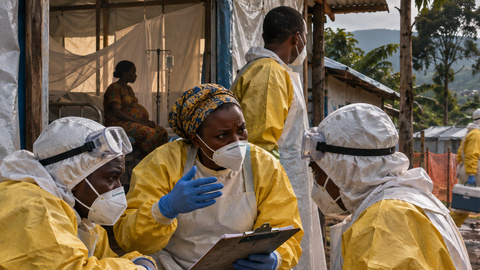
Staff trapped as conflict reaches an Ebola response area
On November 22, 2026, World Health Organization Director-General Tedros Adhanom Ghebreyesus said fighting near a hospital in eastern Democratic Republic of Congo's Ituri province had forced health workers and humanitarian partners to shelter in its maternity ward for more than 24 hours. He said the clashes were occurring close to where a major Ebola outbreak first emerged and had disrupted both the hospital and the broader response.
WHO and aid partners were working to arrange safe movement for personnel. Early reporting did not establish that everyone had been evacuated or that normal healthcare operations had resumed. The warning concerned immediate danger to patients, families, local health workers and humanitarian responders.
Why violence makes an outbreak harder to control
Ebola response work depends on identifying suspected cases, providing care, tracing contacts, safely transporting supplies and people, communicating with communities and protecting healthcare workers. When armed groups operate around medical facilities, patients may avoid seeking care, responders may be unable to travel, and families may be displaced into harder-to-reach areas.
The health emergency therefore has two connected dimensions: disease transmission and the security environment necessary to control it. A vaccination campaign or treatment protocol has limited reach if nurses cannot safely access a clinic.
Scale of the epidemic
Reuters reported that official figures exceeded 11,000 infections and 5,500 deaths since the outbreak was declared May 15, 2026. A separate November 17 snapshot cited in other contemporary accounts placed totals at 11,613 cases and 5,678 deaths. These figures should not be mixed without dates or treated as a final count; surveillance is difficult during an active outbreak and numbers can be revised.
WHO identifies Bundibugyo Ebola virus as the outbreak's cause and notes that no specific approved vaccine or treatment for that species was available at this reporting stage, while investigational vaccine research continues. General information about vaccines for other Ebola species should not be assumed to apply automatically here.
Who is responsible for the fighting?
Eastern Congo has suffered prolonged conflict involving multiple armed organizations, government forces and foreign-linked actors. Contemporary reports connect insecurity with various armed groups across Ituri and neighboring North Kivu. WHO's immediate hospital warning did not publicly establish the identity of every combatant involved in the nearby clashes.
That distinction matters. Explaining the longer conflict and reported armed groups helps readers understand the threat, but assigning responsibility for a particular incident requires evidence not supplied by a general description of regional violence.
The humanitarian dilemma
Medical workers have obligations to treat patients regardless of their political allegiance, while parties to conflict must respect protections afforded to medical facilities and personnel under applicable humanitarian law. In a high-transmission outbreak, attacks and road closures can have consequences far beyond the immediate fighting.
Public-health professionals warn that interruption of care can increase delayed diagnosis, exposure and deaths from both Ebola and unrelated medical conditions. Maternity services are themselves especially vulnerable when a ward becomes temporary shelter for responders.
What to watch next
The most immediate questions are whether staff and patients can leave safely when appropriate, whether the hospital can function, whether response teams can reach affected villages, and whether infection-surveillance indicators change after the disruption. Follow dated WHO statements, situation reports and verified access updates rather than assuming the situation is resolved.